
Startup Art Fair Post-Mortem
What I Did Right, What I’d Do Differently

Just came back from Startup Art Fair and my brain is still recovering (seriously, words stopped working for about three days). But now that I can think again, here’s what went down.
What I Did Right
The goal wasn’t money. We sold over $7,000 worth of art—a couple Call and Response books, couple of $3–5 zines, drawings from the Perceive Me nude portrait sessions for $30 each (someone bought seven of theirs!), couple of Perceive Me prints and catalogs. But that wasn’t the point.
The point was showing what I could do—organizing, putting on an event, being efficient, supporting other artists, getting the message out there about body image. People saw the work. New eyeballs. New conversations. The panel discussion about being seen and taking up space resonated with the whole audience. Recognition. Validation. The conversations.
What happened in the nude portrait sessions. This is the part that still gets me. People from the public—not professional models, just people—signed up to pose nude for professional artists. Twenty minutes on the model stand while multiple artists worked simultaneously in charcoal, pencil, pastel. And what they discovered in those twenty minutes was the gap between how harshly they see themselves and how tenderly artists actually perceive them.
They bought the “unflattering” angles. Because the artist rendered them with such care that they couldn’t see what was unflattering about it anymore. That’s the whole thing. That’s what Perceive Me has always been about and watching it happen for other people, not just me—it never gets old.
Last-minute additions that worked. I put little quotes on the walls in both the Call and Response room and the Perceive Me room. Total last-minute thing. People loved them. They stopped, they read them, they engaged. “Oh my god that percentage, I feel like it’s more than that.” Those little text moments gave people entry points.
I hired art transport. I’ve moved art so many times and been exhausted. I wasn’t doing that again. Outsourcing when you can is self-care.
I started early. Six months out I was posting about it, building anticipation, letting people know this was happening. By three weeks before, I was basically ready to go.
The systems I built. This is the part I’m genuinely proud of. Running two rooms—a Perceive Me exhibition space and a live nude portrait session room next door—with volunteers, artists, and members of the public all moving through simultaneously required actual infrastructure. Not hoping it would work out. Systems.
Artist drawing schedules: Spreadsheets with time slots for every artist participating in the nude portrait sessions. Who was drawing when, for how long, in what rotation.
Model sign-up sheets: Sign-up system for members of the public who wanted to pose. Managed onsite, first-come first-served, organized so people knew their time slot, what to expect and felt safe.
Volunteer schedules with task lists: Each volunteer knew exactly what they were doing and when. Staggered shifts across both rooms so there was always coverage. A list of specific tasks so nobody was standing around wondering what to do and nobody had to come find me to ask.
Volunteer hierarchy: Team members—Jennifer, Cerris, Jordan—were the first point of contact for questions and problems. Not me. I was present but not the default answer to every question. That’s the only way this kind of event doesn’t eat you alive.
All of that pre-work is what made it possible to be present—to actually talk to people, to watch what was happening in the sessions, to be in the room instead of running around solving problems that should have already been solved.
What I’d Do Differently (AFGO: Another F*cking Growth Opportunity)
Get a bigger truck. I hired art transport but didn’t plan ahead for how much room I actually needed. We needed more space, a bigger truck. Next time I’m being very specific about measurements, volume and time.
Pay attention to the details ahead of time. My assistant Jordan had to go to Best Buy and Home Depot because I missed a couple things I needed beforehand—adapters for USB lights, other supplies. That’s the kind of thing you can sort out weeks in advance, not the day you’re installing.
Print everything before you get there. I had to come home and print out more labels. Should have printed extras, should have had everything ready to go. Coming home during install to print things is not efficient. But, I am not going to should on myself. Or at least I am going to try not to.
Think about the space conditions. The rooms were warm. I had to bring fans after the fact. If I’d thought about it ahead of time—hotel rooms, lots of bodies, lighting—I could have anticipated that.
These are small mistakes. They happen. And I’m not beating myself up about them. We talk about this at Shoebox all the time—every experience you learn from and you grow from. AFGO. Another f*cking growth opportunity.
The Investment (Let’s Talk About It)
Yes. It was expensive.
Hotel rooms, art transport, lighting, poles, construction, supplies, hiring support. It probably cost me at least $20,000. I did have a small grant which helped. But two thirds of it went on my credit card. And I understand I will be paying that off for a long time.
But the way I make things happen is through the recycling of money. The infrastructure I put together, the investment, the cycling of money through Shoebox, then through events, then through art sales, then back again. It gets recycled over and over again. That’s how this works.
Money goes out for an event. Some comes back through sales. That goes into the next thing. The grant helps. The Shoebox membership fees help. The Substack fees help. The infrastructure—lighting, poles, construction materials—gets used again. And again. And money also goes out to pay for support—updating websites, organizing, working the event. I’m happy to do that. It gives others work. That matters to me too. The investment compounds.
I’m not doing this to make money. I’m doing this for the work, for the message, for the community, for what it builds. But I’m also not pretending it’s free. It costs real money. And I’m carrying that cost because I believe in what it creates. I do it because it’s my life and it’s my passion and it’s my calling and I can’t do anything else.
And yes, I also purchased a couple of the Call and Response art books myself. How could I not? Whether this is a fault of mine or an addiction, let’s not go there. Sometimes I think I can’t go to art shows because I can’t control myself. But the books were just so good. I know the stories behind the collaborations. They’re super special to me. These are all valuable beyond money. So I had to invest in those too.
It’s Okay to Take a Break
Know that it’s okay to take a break when it’s all said and done. It’s okay to rest. It’s okay to say I’m not gonna do this again for a while because I can’t.
It took a lot of organizing, a lot of mental strength and resilience, a lot of physical stuff that my body is still recovering from. I need to do self-care. Take care of myself for a while.
And realize that after talking to all the people and having to be “on” all the time, it’s okay to want to be quiet and not have to talk to anybody.
The Big Picture
It was an amazing experience. Not about the money. About showing up, doing the work, supporting artists, getting important messages out there. About eyeballs and conversations and people seeing themselves in the work.
People came. People engaged. People bought their own nude drawings and saw themselves as beautiful. That’s what it was about.
Would I do it again? Absolutely. With a bigger truck, extra adapters, more labels, fans packed from the start, and even spreadsheets (if that is possible).
Document everything. Learn from everything. Do it again better next time. And yes, pay off the credit card slowly while planning the next thing.
At my own space. Where I have control.
After I rest.
Still Thinking About: How Do I Tell the Story of the Project Itself?
Something I’m still working through after this fair. A lot of people came into the Perceive Me room and assumed I made all of it. They’d look at the work, look at the labels, and still walk away thinking this was my solo exhibition. Even with every artist’s name right there—[artist name] in collaboration with Kristine Schomaker—the concept wasn’t landing the way I need it to.
And I get it. A room full of portraits of the same body reads as one person’s art show. The idea that 100+ different artists each made their own interpretation of my body—that I am the subject, not the maker—that’s not an obvious read. It requires explanation. And I wasn’t giving people that explanation upfront in a way that actually worked.
So now I’m thinking about this: what’s the right text, the right framing, the right story to tell before someone even looks at the first piece? How do I put it out there so clearly that it can’t be misread?
I don’t have the answer yet. Maybe it’s a bigger, bolder intro panel. Maybe it’s the way I talk about it when I’m physically in the room. Maybe it’s language on every label that makes the collaboration undeniable. Probably some combination of all three.
What I know is that people got it once someone explained it to them. Eyes would light up. The whole project landed differently. So the information isn’t the problem—the delivery is. I just have to figure out where in the experience that explanation needs to live so it does the work before I’m standing there to do it for them.
Still working on it. Open to thoughts. Every experience is a learning experience.
Call and Response: People Wanted More
The Call and Response room got a real response. Multiple people said it should travel. People wanted to sign up, wanted to be part of it, wanted to know when the next one was happening. That felt amazing—it always does when the work connects like that.
I had a QR code set up so people could join a mailing list, which was the right call. At least there’s a way to capture that interest and come back to it later. And I will—just not right now.
Because I’m learning, slowly, painfully, but actually learning: I can’t do everything. I physically cannot. I love the idea of Call and Response traveling. I love that people wanted in. And I also just ran a multi-room installation at an art fair for three days, spent over $20,000, and my body is still recovering. So when people asked about future iterations, I told them the truth—I need a break, and I don’t know yet what’s next for it.
Setting that boundary out loud, in the moment, to people who were genuinely excited? That’s new for me. I’m used to saying yes to the good ideas because they ARE good ideas. But yes to everything is how you end up unable to do any of it well.
So: Call and Response will happen again in some form. The mailing list is there. The interest is real. And right now that’s enough. The next iteration will come when I have the bandwidth and the physical capacity to do it justice—and not a moment before.
Still learning. Still setting limits. Getting better at it.
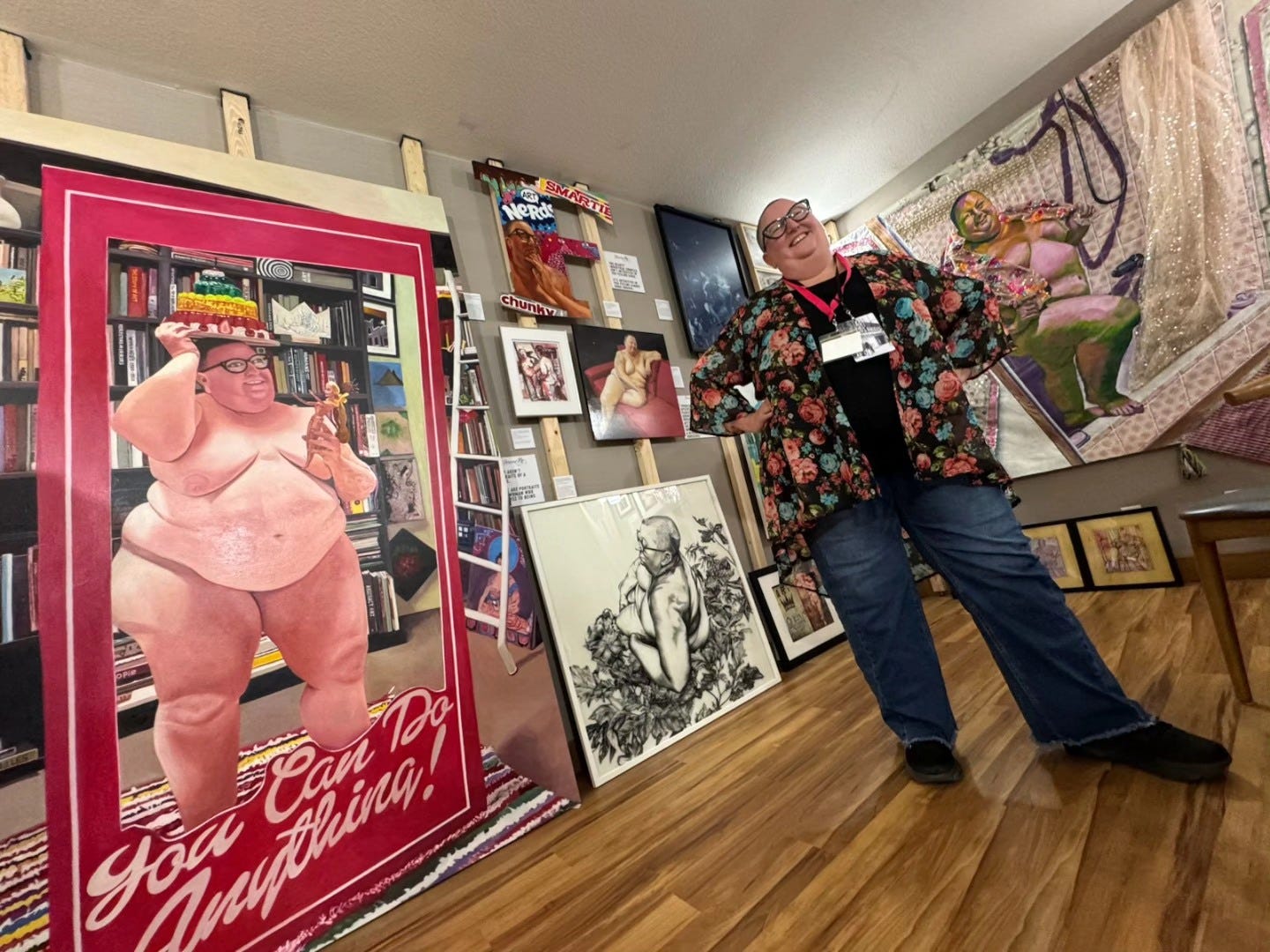
Perceive Me at the Startup Art Fair. Photo by Nancy Kay
This detailed post mortem is yet another good idea.
You're amazing and what you've is incredible. I learn so much from you. Thanks for the detailed post mortem